TL;DR
This article explores why most pet care websites fail to build trust within the first five seconds of a visit. Pet owners arrive emotionally alert, searching for reassurance rather than service details, and they quickly judge a website based on visuals, structure, and authenticity. Generic templates, stock imagery, visual clutter, and hidden trust signals create hesitation before visitors even scroll. The article explains that trust is built through a reassurance-first structure that highlights real photos, visible proof, experience, and a clear booking path immediately. By addressing pet owner fears first and presenting services second, pet businesses can create a calmer first impression, strengthen credibility, and turn more website visits into appointments.
Introduction
Pet owners do not browse pet care websites like casual shoppers.
They arrive with responsibility, attachment, and quiet anxiety.
They are not comparing features.
They are evaluating safety.
Within seconds, they decide one thing:
Is my pet safe here?
If that question is not answered immediately — visually and emotionally — trust weakens.
And when trust weakens, bookings disappear before pricing is even considered.
Many veterinary clinics, grooming salons, and boarding facilities struggle online not because of poor service quality, but because their website does not reflect the care they actually provide.
The issue is rarely competence.
The issue is perception.
The First 5 Seconds Decide Everything
Before reading services, pricing, or location, visitors scan the page subconsciously.
They look for:
- A clean and organized environment
- Real staff and real pets
- Signs of professional experience
- Emotional tone (calm vs commercial)
- Proof that other pet owners trust this place
This evaluation happens instantly.
If these signals are unclear, missing, or feel artificial, the brain categorizes the website as uncertain or risky.
Most pet care websites fail because they open with information instead of reassurance.
They describe services before calming concerns.
And that order is backwards.
The Core Trust Failures Pet Websites Make
1. Generic Visuals
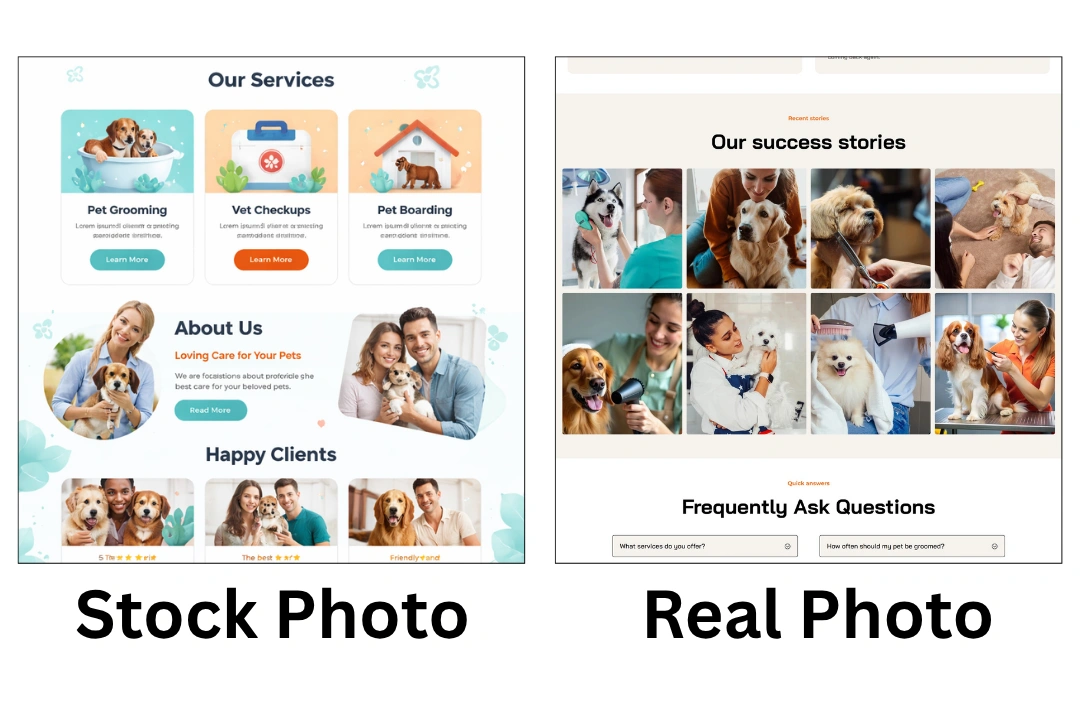
Stock photography creates distance.
Visitors can sense when images are not real. Even if they cannot explain why, they feel it.
A clinic may be spotless and compassionate offline, but online it appears anonymous and commercial because the visuals lack authenticity.
In pet care, authenticity equals safety.
2. Business-First Messaging
Many websites open with statements like:
“We provide professional grooming services.”
Professionalism is expected. It does not reduce anxiety.
Pet owners are looking for reassurance — words like gentle, calm, safe, stress-free, experienced.
Messaging that sounds like a corporate brochure fails to address emotional concerns.
3. Hidden Proof
Reviews, certifications, team bios, and years of experience are often placed far down the page.
But most visitors never scroll that far.
Trust must be visible immediately, not discovered later.
Delaying proof delays confidence.
4. Visual Noise
Crowded layouts signal lack of control.
Too many colors, text blocks, sliders, pop-ups, and competing buttons create subconscious tension.
In care-based industries, visual calm communicates operational control and cleanliness.
Chaos — even visual chaos — reduces trust.
5. Confusing Booking Paths
If visitors feel safe but cannot quickly understand what to do next, hesitation grows.
Multiple booking buttons.
Unclear service categories.
Hidden contact information.
Confusion interrupts confidence.
The Psychology Behind Pet Owner Decisions
Pet care is an emotional risk decision.
Owners silently ask:
- Will my pet be handled gently?
- Will the environment be clean?
- Are these people experienced?
- Do other owners trust them?
- Will my pet feel stressed here?
These fears are rarely spoken, but always present.
Design, layout, photography, and copy are not decorative elements.
They are reassurance mechanisms.
When reassurance is visible, the brain relaxes.
When it is not, the visitor exits.
How to Fix the Trust Problem in the First 5 Seconds
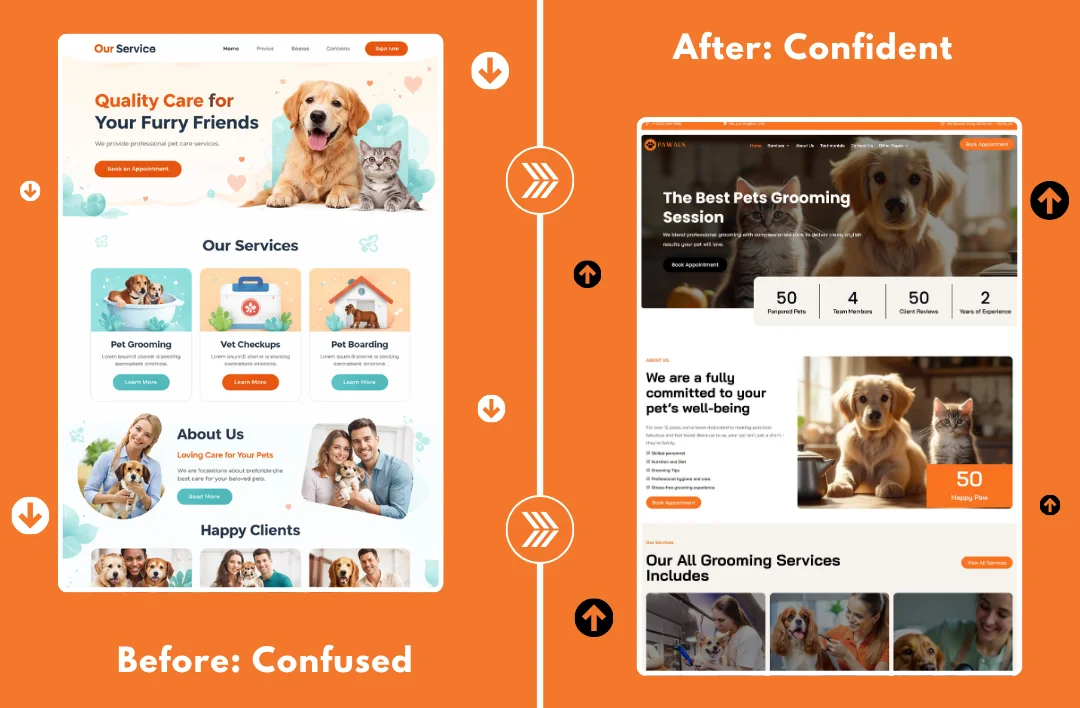
- Understanding the issue is not enough
- The structure must change.
- The objective is simple:
- Remove fear before explaining services
Replace Stock Images With Real Environment Photos
Show reality.
Include:
- Actual clinic or grooming space
- Team interacting naturally with pets
- Treatment, bathing, or boarding areas
- Real client pets (with permission)
Even slightly imperfect real photos build more trust than polished stock images.
Authenticity reduces emotional distance instantly.
Write Headlines That Reassure
Headlines must reduce anxiety before describing offers.
Instead of neutral descriptions, communicate emotional safety.
Examples:
- Gentle, Stress-Free Grooming for Dogs and Cats
- Compassionate Veterinary Care Focused on Comfort
- Safe Boarding Designed for Anxious Pets
The first message must calm, not sell.
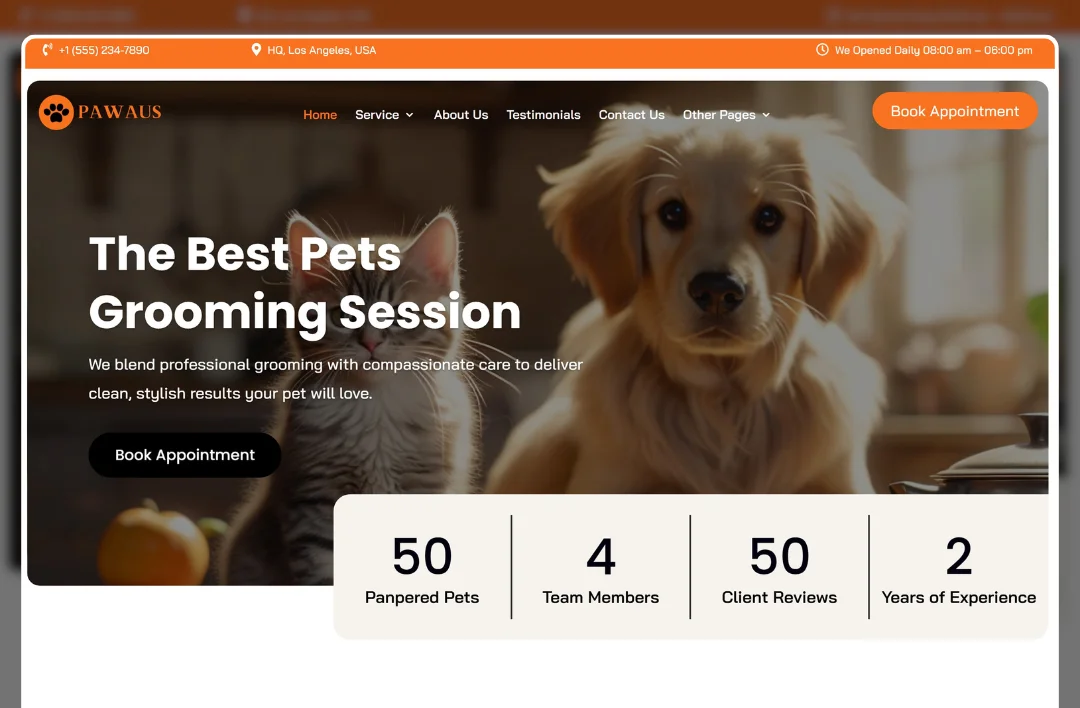
Place Trust Signals Above the Fold
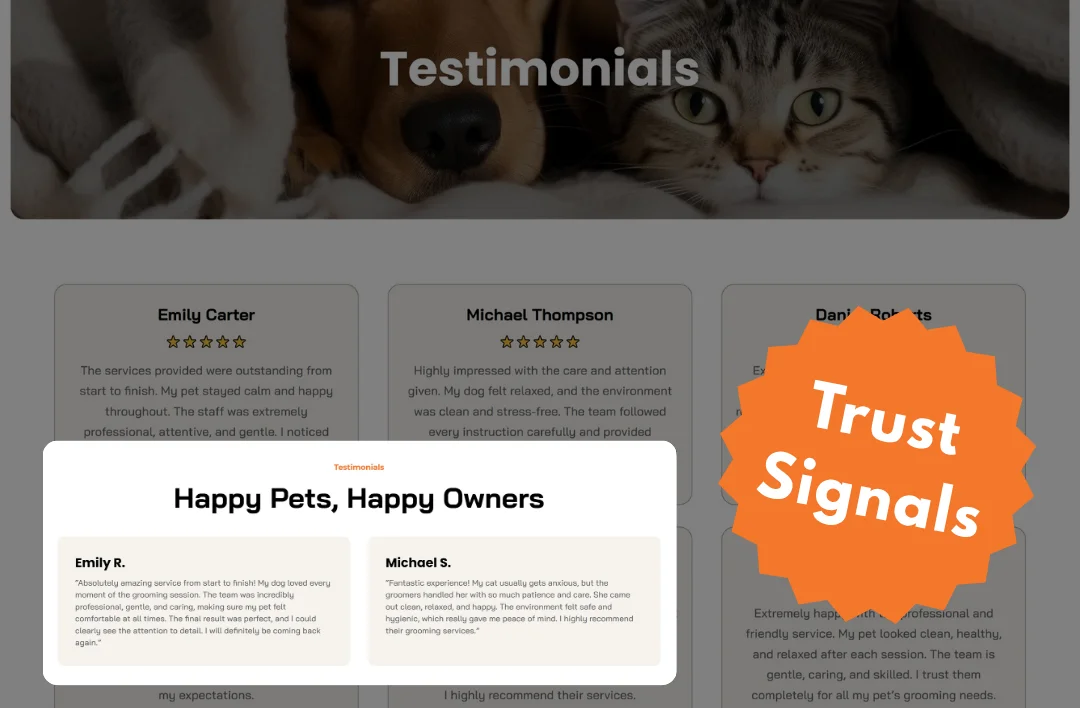
Do not bury credibility.
Show immediately:
- Star ratings or testimonials
- Certifications or licenses
- Years of experience
- Staff introductions
- Hygiene and safety statements
Trust signals must appear within the first visible screen.
Reassurance delayed is reassurance weakened.
Simplify Layout to Create Visual Calm
Reduce visual complexity.
Limit:
- Excess colors
- Long unbroken paragraphs
- Overlapping calls-to-action
- Heavy design effects
Use whitespace and hierarchy intentionally.
A calm layout signals organized operations.
Create a Clear First Action
Once visitors feel safe, they look for direction.
Provide:
- One clear booking button
- A visible call option
- Clear service navigation
- A short reassurance near the call-to-action
Clarity turns comfort into commitment.
Align Messaging With Pet Owner Emotions
Every section should answer a concern.
If you describe grooming, mention the handling style.
If you show boarding, mention supervision and cleanliness.
If you present veterinary services, highlight care and experience.
When messaging mirrors emotion, trust compounds across the page.
Structure Pages Around Reassurance First
Most websites follow:
Services → About → Contact
Trust-focused websites follow:
Reassurance → Proof → Experience → Services → Booking
This structural shift transforms websites into appointment systems instead of digital brochures.
The Real Outcome of Fixing the First 5 Seconds
When trust is established immediately:
- Visitors stay longer.
- They explore services.
- They hesitate less.
- They book faster.
The improvement does not come from better graphics.
It comes from emotional alignment.
Pet care brands that understand this move from being an option to becoming the safe choice.
Final Insight
Many pet businesses assume growth depends on ads, SEO, or competitive pricing.
But most conversion problems begin earlier.
They begin with trust.
A pet care website is not a brochure.
It is a reassurance environment.
Brands that design around emotional clarity, visible proof, and structural calm build stronger authority — the foundation behind trust-first systems developed through platforms like Themesrush.
The first five seconds are not a design moment.
They are a positioning moment.
Win those five seconds — and everything after becomes easier.