TL;DR
Most HVAC websites fail not because of traffic, SEO performance, or visual design quality, but because they are built to attract visitors instead of guiding decisions.
Qualified HVAC leads come from structural alignment between how homeowners search and how the website is architected.
When a website operates as a lead system rather than a marketing brochure, traffic becomes locally relevant, intent becomes clearer, and conversion behavior becomes predictable.
The strongest HVAC websites are not visually impressive first. They are operationally intelligent first.
Introduction: The Real Problem Isn’t Traffic
When contractors say their website is not generating leads, the immediate assumption is usually that more traffic is required.
This assumption feels logical but is incomplete.
Many HVAC websites already rank in search results. They receive impressions and visitors consistently. However, those visitors often leave without contacting the business.
The real problem is not visibility. It is structural misalignment between website architecture and homeowner search behavior.
HVAC searches are rarely casual browsing activities. Most searches happen when people are experiencing discomfort, inconvenience, or system failure. Even when the situation is not emergency driven, it is still intent driven.
Homeowner decision behavior is shaped by three primary signals:
- Local proximity
- Service relevance
- Trust confirmation
If these signals are not organized clearly inside the website structure, marketing effort produces passive traffic rather than operational demand.
The Structural Mistake Most HVAC Websites Repeat
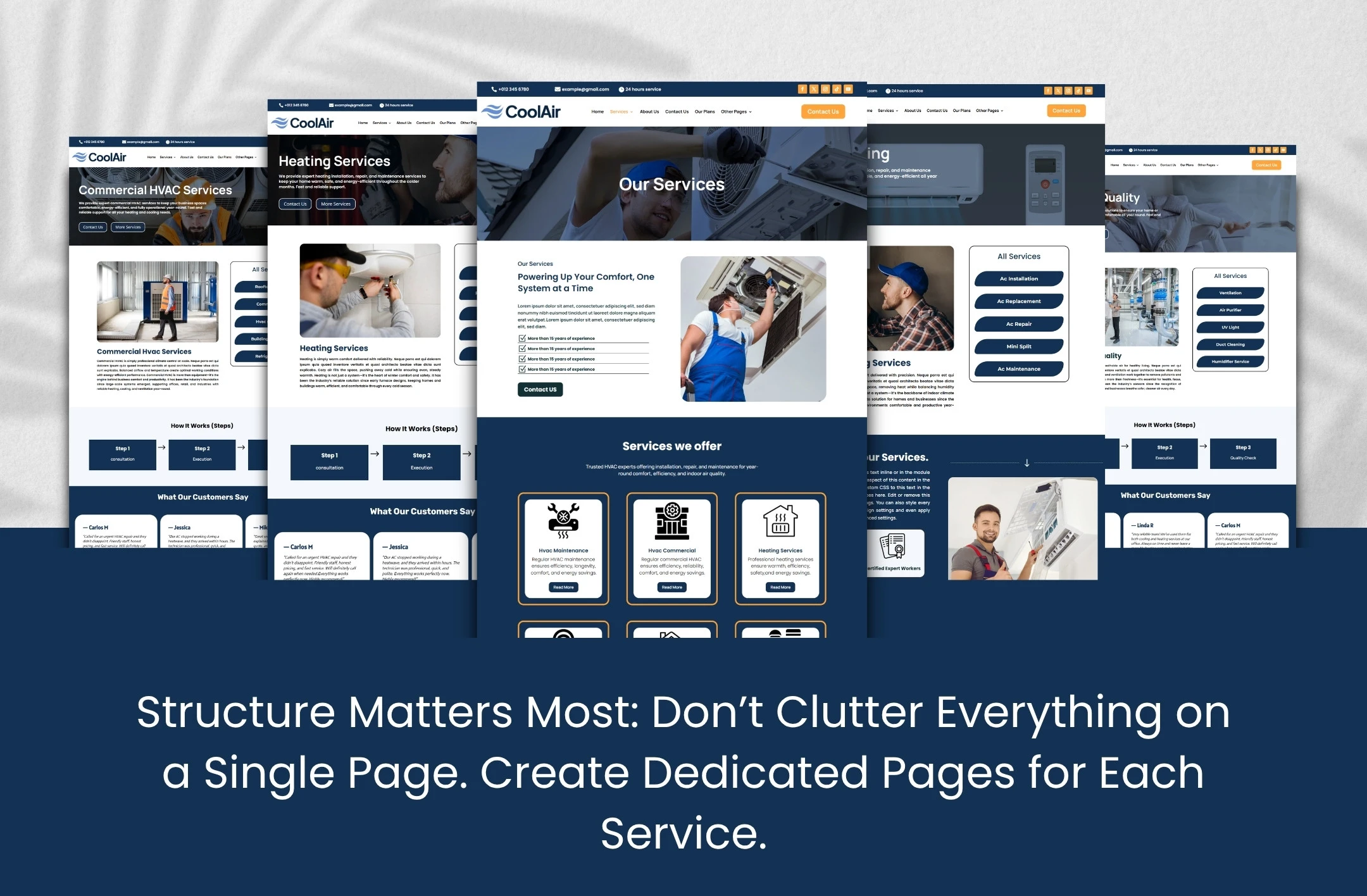
Everything Is Compacted Into One Service Page
The most common architectural mistake is compressing every service offering into a single page.
Heating repair, AC installation, maintenance programs, indoor air quality solutions, and ductwork services are often presented together.
From the contractor’s perspective, this feels efficient because everything is visible in one location.
But from search engines and visitors, it creates confusion.
When someone searches for something specific like “furnace repair in Queens”, they want a page that directly discusses furnace repair.
They do not want to navigate through unrelated HVAC offerings first.
Intent requires specificity.
Service segmentation strengthens both search authority and visitor confidence.
Geographic Structure Matters More Than Most Contractors Realize
Many HVAC businesses operate inside defined service zones but fail to represent that structure clearly online.
Some websites attract visitors from regions they do not physically serve. Others rank for general HVAC terms without location alignment.
This creates two operational problems.
First, search engines receive weak local entity signals.
Second, visitors outside the service radius inflate traffic numbers without contributing to revenue.
Traffic from another city or state rarely becomes a qualified lead.
Qualified HVAC demand is always local.
A better approach is to structure pages around service and location combinations such as:
- AC Installation in Brooklyn
- Furnace Repair in Queens
- Emergency HVAC Service Near Manhattan
This architecture aligns digital visibility with real business operation.
Homepage Architecture and Lead Perception
The first visible section of your website influences conversion behavior more than many contractors realize.
Within seconds, visitors are subconsciously evaluating three questions:
- Is this business local to me?
- Do they handle my exact problem?
- Can I contact them immediately if needed?
Many HVAC websites begin with generic messaging such as “Quality HVAC Solutions” paired with stock imagery.
It looks professional. But it communicates nothing specific. Professional appearance alone does not create operational clarity.
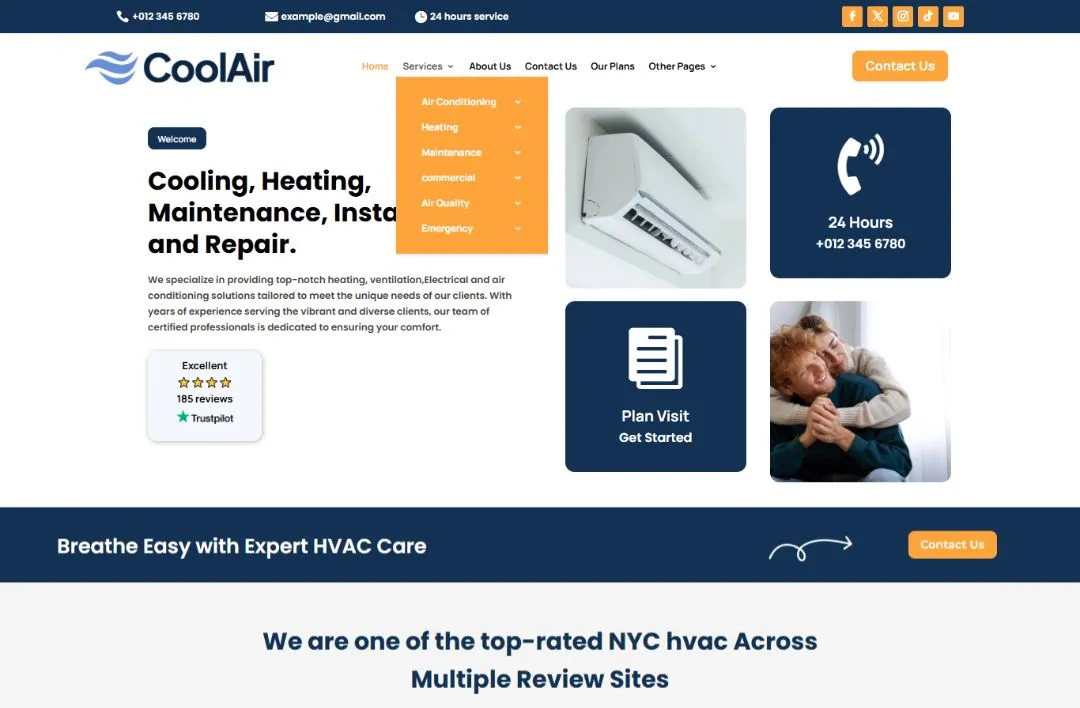
The homepage must communicate capability before explanation. The above-the-fold area is not a marketing banner. It functions as a decision gateway that reduces uncertainty.
Traffic Is Not the Same as Qualified Leads
This is one of the biggest industry misconceptions.
Contractors often believe more traffic automatically means more business.
In reality, a website can rank broadly for HVAC services and still fail to produce meaningful inquiries. This happens when visitor intent is informational rather than transactional.
A qualified HVAC lead usually behaves differently.
They typically:
- Search using service + location phrases
- Spend time inside a specific service page
- Check review evidence quickly
- Contact or submit forms without extensive browsing
They are not exploring options.
They are solving a problem.
Websites built around broad keywords prioritize exposure.
Websites built around structured intent capture actual customers.
Trust Signals Must Be Positioned Strategically
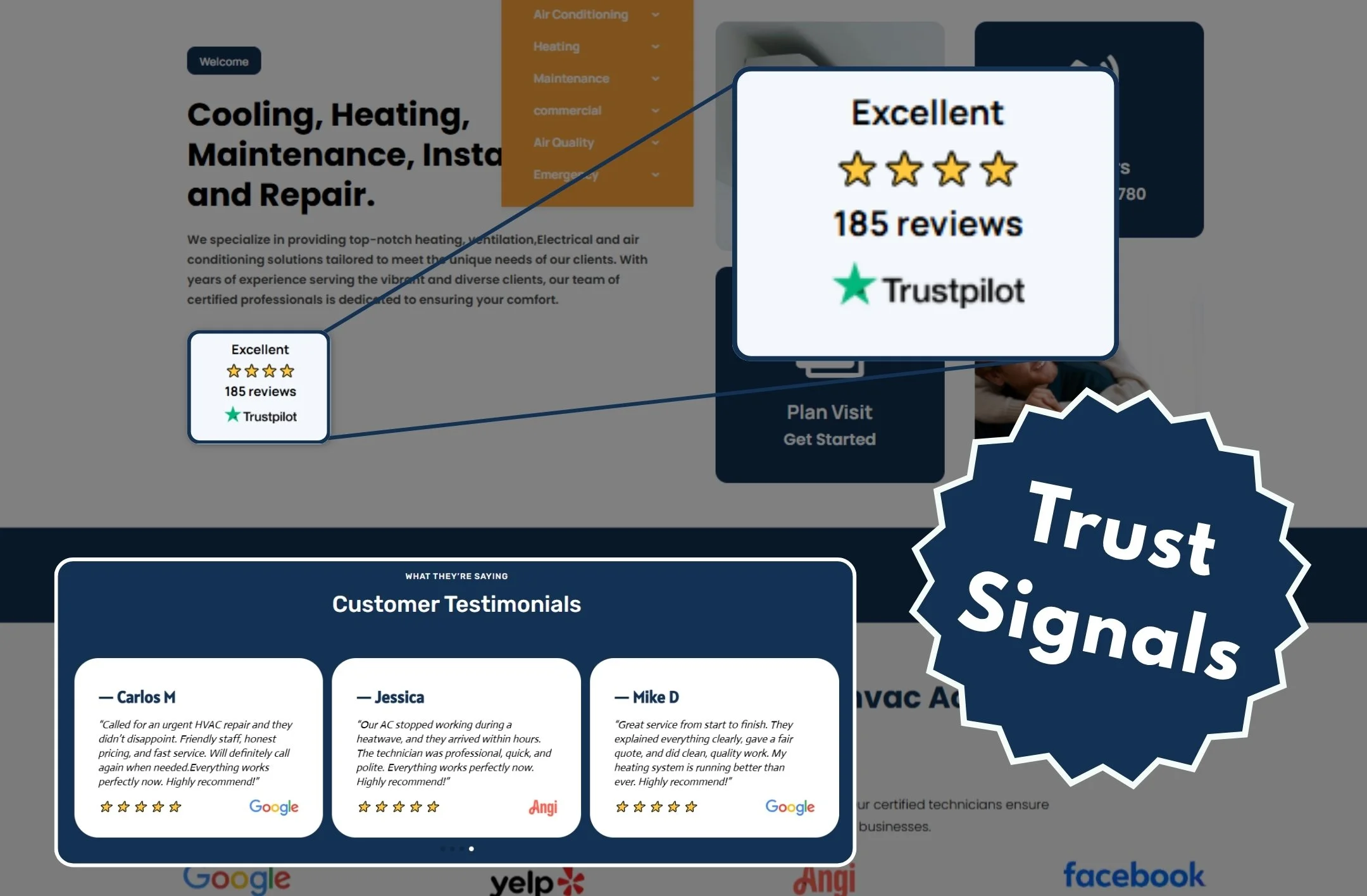
Most HVAC companies already possess credibility assets:
- Customer reviews
- Industry experience
- Certifications
- Service guarantees
The problem is not lack of trust.
The problem is trust placement.
Common structural mistakes include:
- Reviews isolated on separate pages
- Certifications hidden inside long paragraphs
- Guarantees mentioned once without reinforcement
- No connection between trust evidence and service pages
Trust becomes effective only when it appears during evaluation moments.
For example:
If someone is reading furnace repair information, nearby reviews mentioning fast response time strengthen confidence.
If someone is evaluating installation services, visible warranty statements reduce hesitation.
Trust should support decision action rather than remain passive.
The Design Illusion in HVAC Websites
Many contractors believe redesigning the website will automatically improve lead generation.
They invest in modern typography, animations, and visual upgrades.
The website looks newer.
Conversion behavior often remains unchanged.
The reason is simple.
Infrastructure did not change.
If service hierarchy is unclear, geographic targeting is weak, trust signals are scattered, and call pathways are hidden, design upgrades become cosmetic improvements.
Performance is determined by structural architecture. Design improves usability. Structure determines conversion capability. When both work together, performance improves.
When only design changes, business outcomes rarely shift significantly.
The Solution: System-Built HVAC Websites
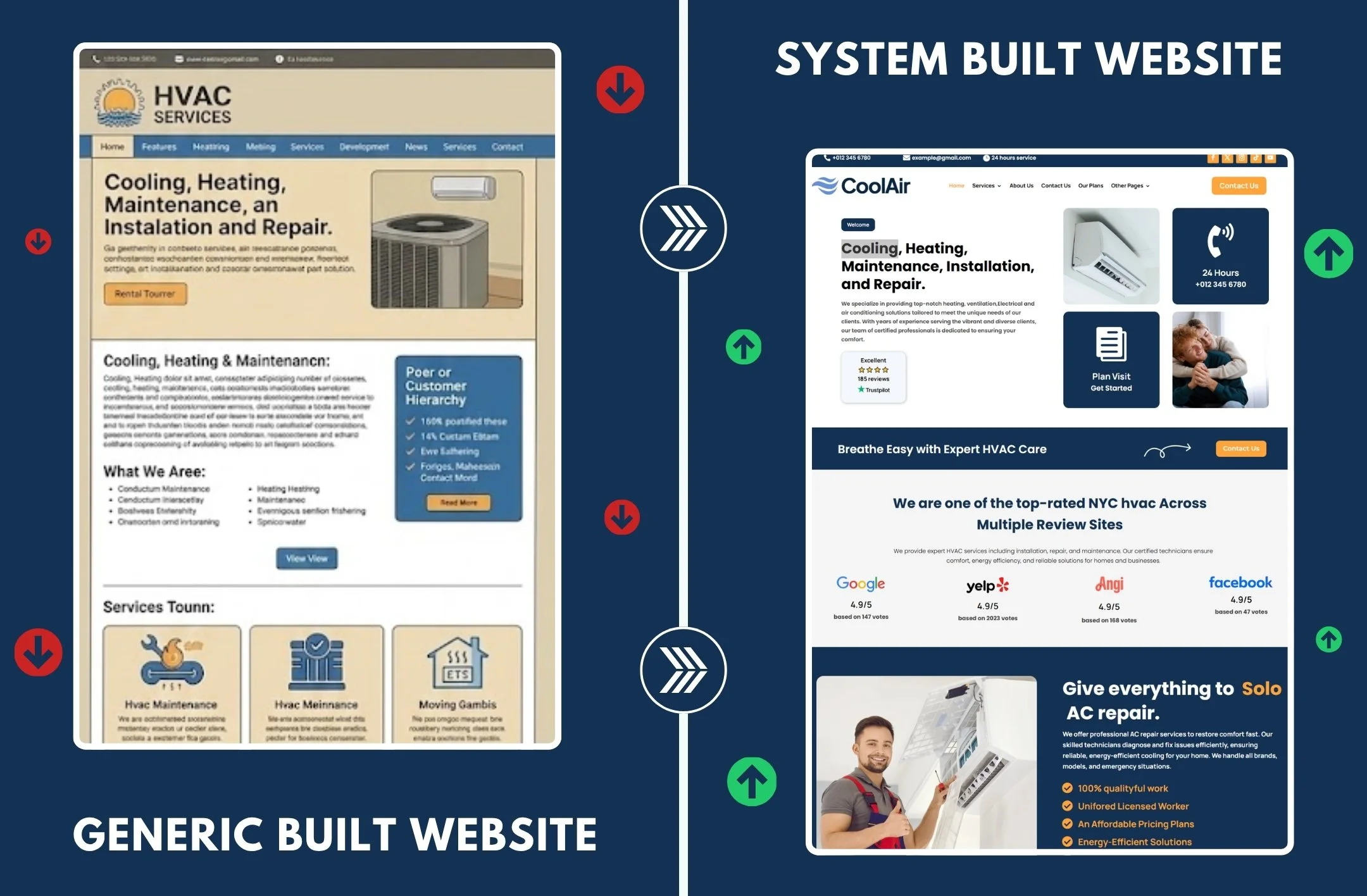
High-performing HVAC websites share a consistent characteristic: clarity before detail. They guide attention rather than presenting everything equally.
Visitors immediately recognize what problem is handled, how reliable the company feels, and what to do next. System-built websites achieve this through a combination of structure, trust, and operational design.
Prioritize Urgent Services Above-the-Fold
The first visible section of the website should highlight emergency or high-value services. Above-the-fold placement ensures that homeowners immediately see what they need without scrolling.
Structured Service and Location Pages
Service and location pages must reinforce clarity. Visitors should quickly understand which services are offered in which locations. This reduces friction, guides recognition, and pre-qualifies leads naturally.
Display Trust Signals
Trust is communicated through verified reviews, guarantees, and technician credentials. When these signals are visible and consistent across the site, visitors perceive reliability without having to think consciously.
Consistent Navigation and Clear Calls-to-Action
Navigation should feel seamless. Every service page should guide the visitor toward action: click-to-call, booking forms, or contact details. Calls-to-action should be prominent, responsive, and easy to use, particularly on mobile devices.
Comparison Table: Generic vs System-Built HVAC Websites
| Feature / Factor | Tempra HVAC Template | Generic Marketplace Theme | Custom Agency Build |
|---|---|---|---|
| Built For | HVAC & Plumbing Pros - high conversion | Every industry - optimized for none | Your brand - built from scratch |
| Urgent Services (Above-the-Fold) | Immediately visible - prioritized for emergencies | Often buried or missing | Custom designed for your specific USP |
| Service Pages | Dedicated pages - structured and decision-oriented | All services on one page - low clarity | Each page is billed individually ($$$) |
| Trust Signals | Verified reviews, technician photos & guarantees | Stock photos, no reviews, minimal proof | Custom case studies and high-end media |
| Navigation & Hierarchy | Logical, consistent, and easy to follow | Confusing, all services lumped together | Fully bespoke - can be complex to manage |
| Calls-to-Action (CTAs) | Prominent, clickable phone & booking buttons | Hidden or inconsistent | Integrated with custom CRM/Software |
| Conversion Focus | Pre-qualification system - filters unqualified leads | Passive browser, traffic-focused | Deep funnel optimization at extra cost |
| Mobile Experience | Fast, clickable CTAs, responsive layout | Slow, confusing, hard to act | Highly optimized, but expensive to maintain |
| Tracking & Analytics | Integrated call/form tracking for insights | Often missing | Full enterprise-grade data reporting |
| Operational Flexibility | Upgradeable, Divi editable, branding consistent | Limited - hard to scale | Developer needed for every small change |
| Performance | Lightweight - fast loading, no bloat | Slow - unnecessary plugins by default | Optimized, but at extra cost |
Pros & Cons of System-Built HVAC Websites
Pros:
- Prioritizes urgent, high-value services
- Builds trust instantly with reviews, guarantees, and technician credentials
- Guides visitors toward action (calls, forms)
- Filters unqualified leads automatically
- Supports operational flexibility and future growth
Cons:
- Requires careful design planning
- Needs consistent updates to maintain authority
What Happens After Structural Optimization
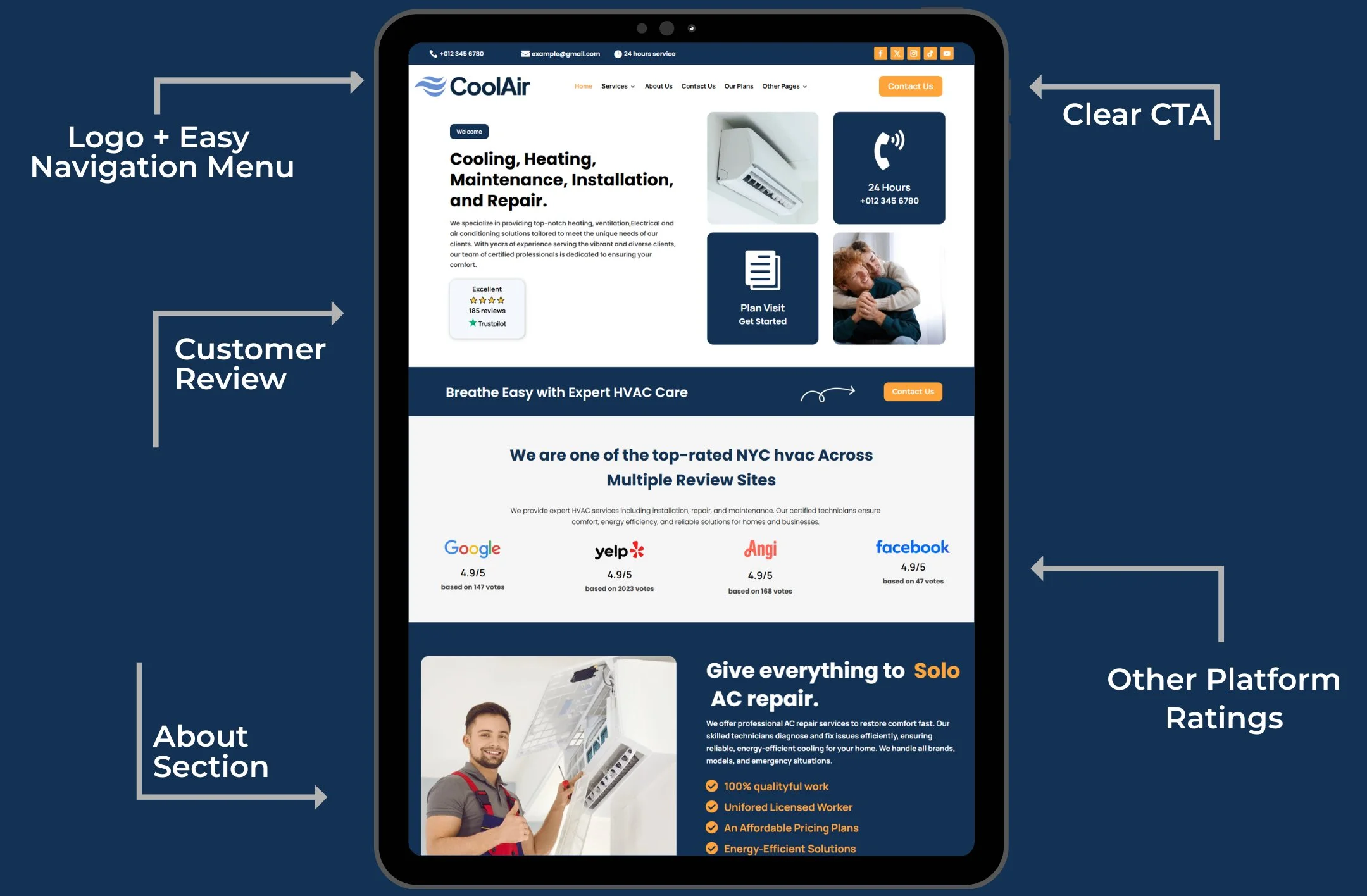
When HVAC websites are rebuilt around structured service segmentation, geographic alignment, and trust placement, measurable behavioral changes appear.
Bounce rates usually decrease because visitors encounter relevant information immediately.
Search engines begin associating the business with specific service-location entity combinations rather than diluted keyword signals.
But the most meaningful change is conversational.
Contractors begin receiving more targeted inquiries.
Instead of generic questions, calls sound more operational:
- Do you provide furnace repair in Brooklyn?
- Can you install AC systems in Manhattan this week?
The website starts pre-qualifying leads before human interaction begins.
This improves closing probability and shortens sales cycles.
The Core Industry Misunderstanding
Many HVAC contractors believe professional design alone creates business growth.
It does not.
High-performance HVAC websites require four structural components working together:
- Clear service segmentation
- Geographic alignment
- Immediate decision signals
- Visible action pathways
Without these components, traffic remains passive.
With them, traffic becomes operational demand.
Authority is not communicated visually.
Authority is constructed structurally.
EEAT and Entity Authority Integration
From an EEAT perspective, structured HVAC websites demonstrate expertise through consistent operational logic.
Experience is communicated through service specialization.
Authority is reinforced through local presence, review integration, and structured service architecture.
Trustworthiness appears when visitors can quickly verify business capability, contact accessibility, and reputation evidence.
This design philosophy also supports long-term entity recognition inside search ecosystems and local map indexing.
Conclusion: Structure Determines Lead Quality
Most HVAC websites do not fail because of competition, marketing effort, or design quality.
They fail because they are built generically.
They attempt to appear complete rather than operate intelligently.
They chase traffic instead of intent.
True performance emerges when service clarity, geographic precision, trust reinforcement, and decision architecture work together.
A high-performing HVAC website is not just visually attractive.
It is a structured system engineered to convert visitors into qualified customers before the first phone call happens.