

TL;DR
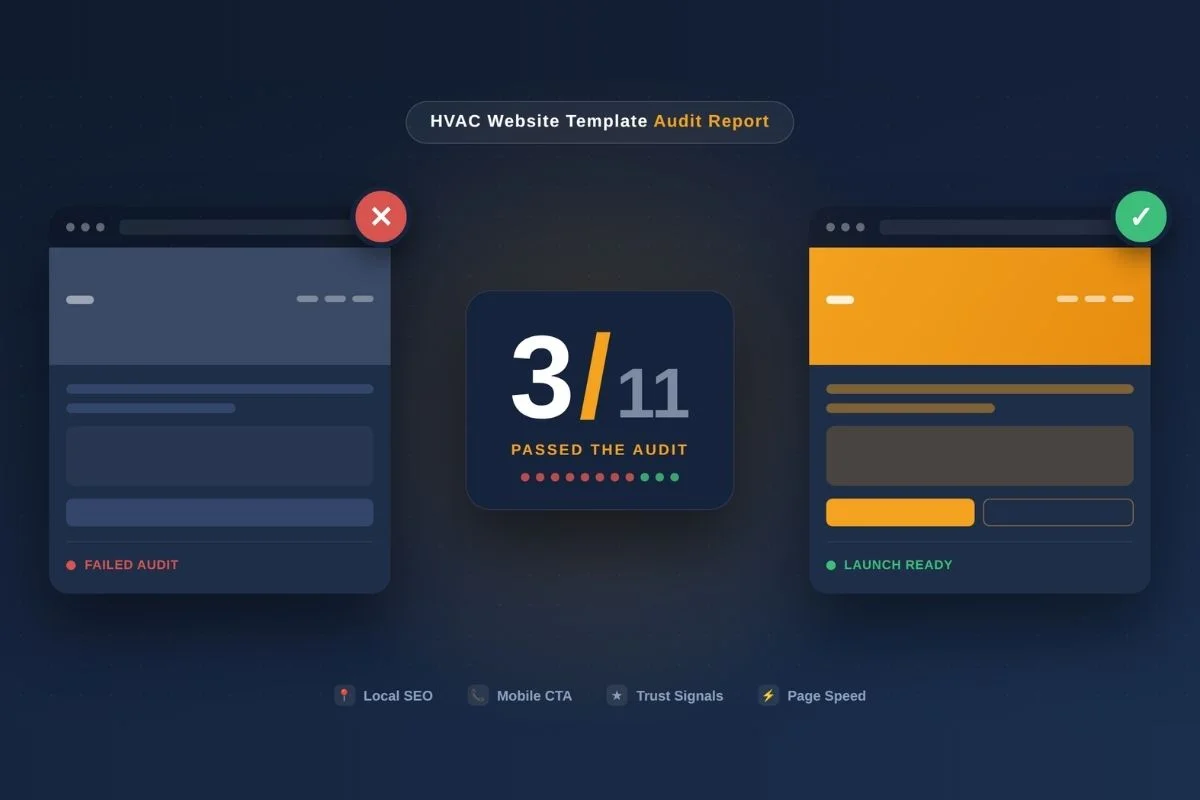
Six months. A live website. Zero calls. That is what the wrong HVAC website template looks like in practice, not broken, not ugly, just invisible to Google and useless to anyone who lands on it.
The problem is almost always structural: one generic services page instead of dedicated pages per service, no phone number visible on mobile, no trust signals, no room to grow into local search.
Check those four things on the live demo before you spend a dollar. If it fails even two of them, the template was never going to make the phone ring.
The Call That Changed How I Build HVAC Websites
Most contractors who come to me do not know their website is the problem. They think it is the market. Or their pricing. Or they need more ads. The website looks fine, it is live, it loads, it has their services listed. So it never gets blamed.
That assumption has cost more businesses more money than any bad ad campaign ever has.
One of them was a heating and cooling contractor in the US. AC repairs, furnace installs, vent work. Normal bread-and-butter HVAC business. He had a website. It had been live for six months.
Zero calls. Not a single lead. Not one.
When he reached out to me, he thought the problem was his Google Ads budget. Or maybe his pricing. Maybe the market was slow.
I looked at the site within five minutes and knew exactly what had happened. Someone had handed him a template, called it a website, and walked away.
What I Found on That Site
I have looked at dozens of HVAC websites across my work at Remote Sharks. Most of the bad ones share the same problems. But this one had all of them at once.
No Local Signals Anywhere
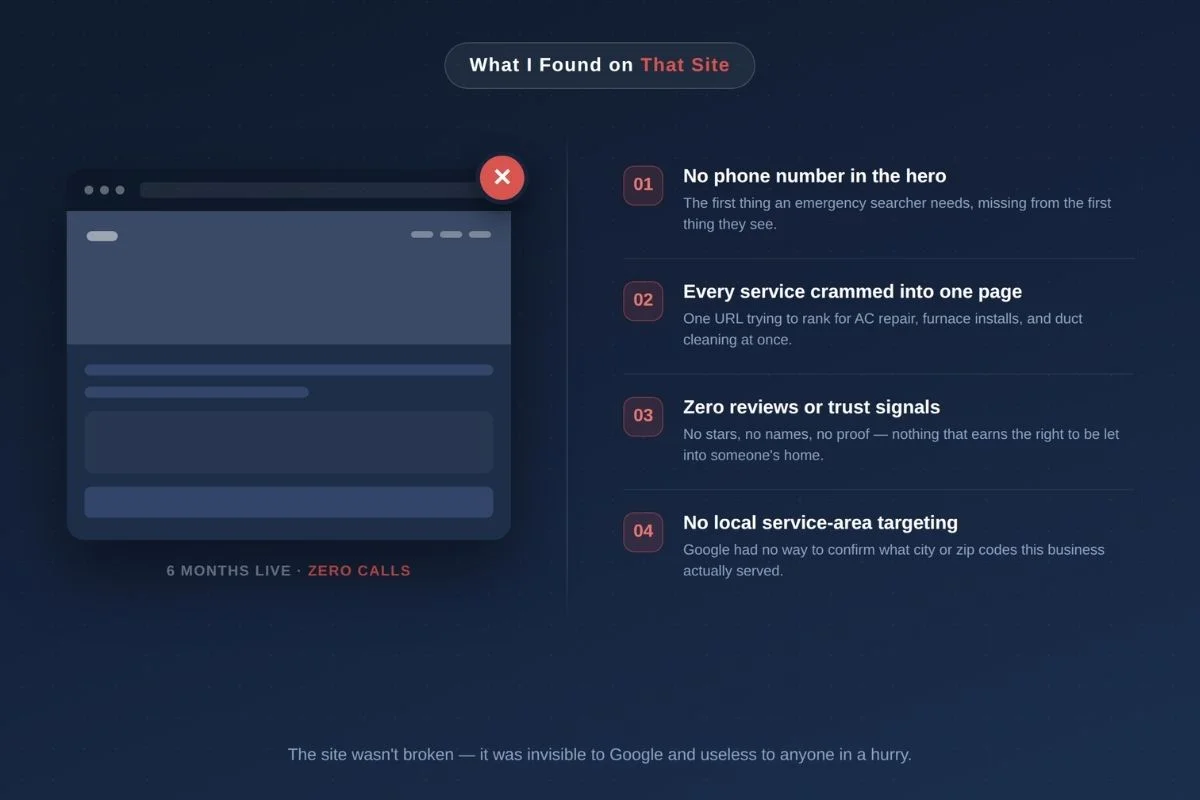
No local signals anywhere. The site had no way to tell Google what city this business served, what zip codes it covered, or where the jobs actually happened.
Google had no reason to show it to anyone nearby. It was not penalised, it was just invisible, like a shop with no sign and no address.
Every Service Crammed Into One Page
AC repair, furnace installation, duct cleaning, maintenance plans, all sitting on a single page called "Services." One URL. One page. One shot at ranking. That is not how people search for HVAC work.
Someone searching for furnace installation in December is not the same person searching for an AC tune-up in June. Google knows that. The site did not.
No Trust Signals
Not a single review. No star rating. No customer name. No before-and-after. Nothing that told a stranger they could trust this company with access to their home. In a service industry where you are literally asking someone to let you inside their house, trust is not optional. It is the sale.
The Hero Section Had No Phone Number
HVAC is an emergency industry. AC goes down in July. Furnace dies in January. People search on their phones in a panic. They land on a site. They want one thing: a number to call right now.
The hero section had a banner image. A tagline. And a button that went to a contact form.
A contact form. For an emergency service business.
Six months live. Thousands of potential leads are gone. The site was not broken, it was just built for a world where customers have patience, and HVAC customers never do.
Why This Keeps Happening
This contractor's situation is not unusual. I see it repeatedly. And the root cause is almost always the same: someone picked a template based on how it looked in a screenshot.
That is the wrong filter entirely.
A good-looking template and a launch-ready HVAC template are two completely different products. One is a design asset. The other is a business system.
Most templates sold on general marketplaces are design assets. They are built by designers who have never run a service business, never studied how HVAC customers search, and never had to answer for whether the phone actually rang.
If the creator built the template without caring whether it would rank or convert, why would the template care either?
This is the problem I kept running into when working with HVAC clients at Remote Sharks. We never used off-the-shelf marketplace templates. Every structure we built was custom, informed by real client data, real search behaviour, and real conversion patterns. Over time, those structures became repeatable.
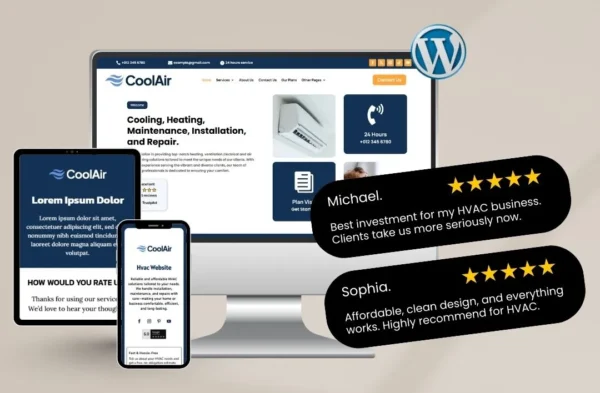
That is what eventually became Tempra, part of our HVAC website templates collection at Themesrush.
But before I tell you what makes a template actually ready to launch, let me show you what we found when we examined the field.
What We Found When We Looked at 11 HVAC Templates
We pulled templates from the major marketplace platforms, WordPress theme directories, Envato, ThemeForest, and a handful of niche template sellers. We applied the same criteria we use when auditing live HVAC client sites at Remote Sharks.
The criteria were not about aesthetics. They were about function:
- Does it have dedicated pages per service, not a single service dump?
- Can you add city pages and service areas later without rebuilding everything from scratch?
- Does the mobile experience put the phone number front and centre on load?
- Are trust signals, reviews, credentials, years in business, built into the layout?
- Is the page speed clean, no unnecessary plugins or bloat killing load time?
- Does the CTA architecture make sense for an emergency-first service business?
Out of 11 templates reviewed, 8 failed on at least three of those criteria. Three passed. Here is the breakdown of what the failures looked like:
| Failure Type | How Many Templates Had It | Real-World Cost |
|---|---|---|
| Single generic services page | 9 of 11 | One URL to rank for everything, you rank for nothing |
| No local SEO structure | 8 of 11 | Google cannot confirm your service area |
| Phone number buried or missing on mobile | 7 of 11 | Emergency searches bounce immediately |
| No review or trust section | 10 of 11 | Strangers have no reason to choose you |
| Slow load from plugin bloat | 6 of 11 | Google penalises it before a customer even sees it |
| Generic hero copy | 11 of 11 | Looks like every other site, no differentiation |
That last row is worth pausing on. Every single template we reviewed had generic hero copy. Everyone. Because a template cannot write your positioning for you, but most templates do not even give you a structure that demands strong positioning.
They give you a placeholder. You fill it in. Most people do not.
What the 3 That Passed Had in Common
The templates that cleared our criteria shared the same underlying logic. They were not just visually organised, they were strategically structured.
1. Each Service Had Its Own Page
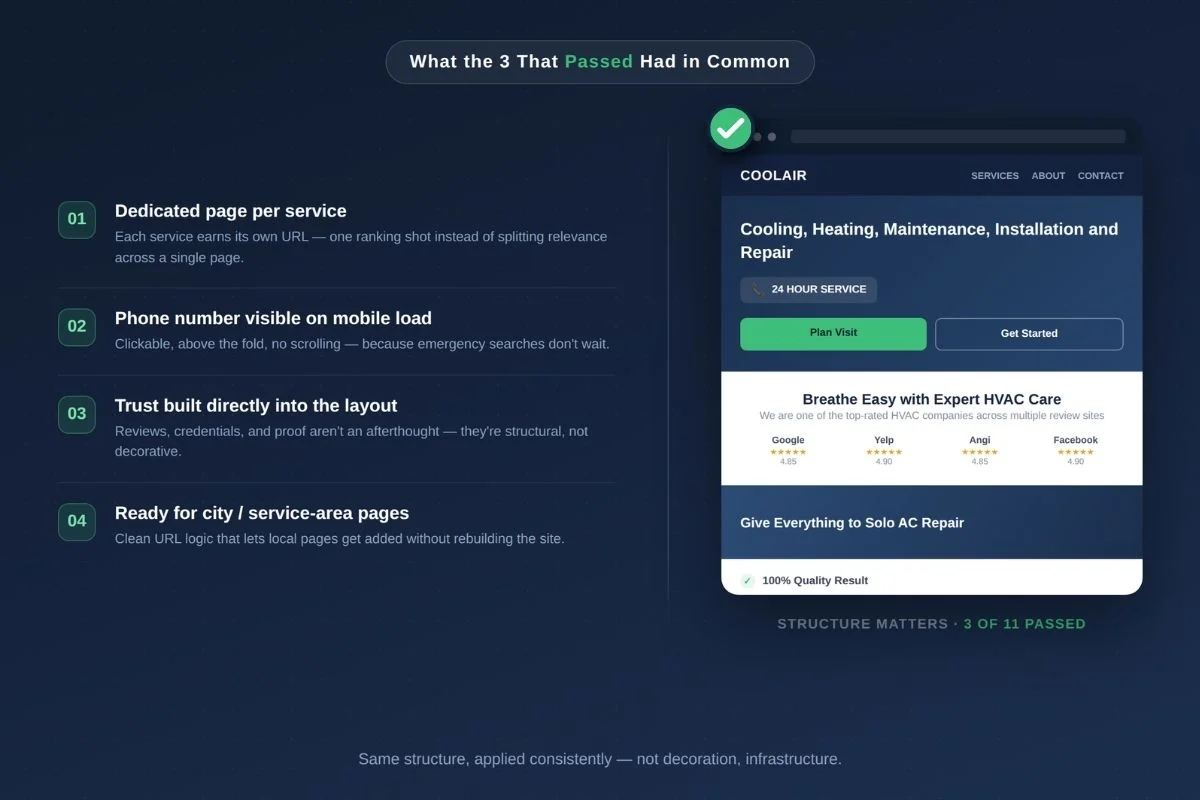
Not a section. Not a tab. A dedicated URL. AC repair had its own page. Heating installation had its own page. Maintenance plans had their own page. This is how Google reads relevance for local searches. One service, one URL, one ranking opportunity.
2. The Mobile Experience Led With the Phone Number
Not a section. Not a tab. A dedicated URL. AC repair had its own page. Heating installation had its own page. Maintenance plans had their own page. This is how Google reads relevance for local searches. One service, one URL, one ranking opportunity.
3. Trust Was Designed Into the Layout
On a phone, the number was visible without scrolling. Clickable. Prominent. Because HVAC customers searching on mobile are usually not browsing, they are in a situation. The template respected that.
4. The Structure Supported Local Ranking
The structure supported local ranking without fighting you. Service area pages could be added without rebuilding anything. The URL logic was clean. And when you were ready to tell Google exactly where this business operated, the template did not get in the way.
The Design Illusion in HVAC Websites
Many contractors believe redesigning the website will automatically improve lead generation.
They invest in modern typography, animations, and visual upgrades.
The website looks newer.
Conversion behavior often remains unchanged.
The reason is simple.
Infrastructure did not change.
If service hierarchy is unclear, geographic targeting is weak, trust signals are scattered, and call pathways are hidden, design upgrades become cosmetic improvements.
Performance is determined by structural architecture. Design improves usability. Structure determines conversion capability. When both work together, performance improves.
When only design changes, business outcomes rarely shift significantly.
The Solution: System-Built HVAC Websites
High-performing HVAC websites share a consistent characteristic: clarity before detail. They guide attention rather than presenting everything equally.
Visitors immediately recognize what problem is handled, how reliable the company feels, and what to do next. System-built websites achieve this through a combination of structure, trust, and operational design.
Prioritize Urgent Services Above-the-Fold
The first visible section of the website should highlight emergency or high-value services. Above-the-fold placement ensures that homeowners immediately see what they need without scrolling.
Structured Service and Location Pages
Service and location pages must reinforce clarity. Visitors should quickly understand which services are offered in which locations. This reduces friction, guides recognition, and pre-qualifies leads naturally.
Display Trust Signals
Trust is communicated through verified reviews, guarantees, and technician credentials. When these signals are visible and consistent across the site, visitors perceive reliability without having to think consciously.
Consistent Navigation and Clear Calls-to-Action
Navigation should feel seamless. Every service page should guide the visitor toward action: click-to-call, booking forms, or contact details. Calls-to-action should be prominent, responsive, and easy to use, particularly on mobile devices.
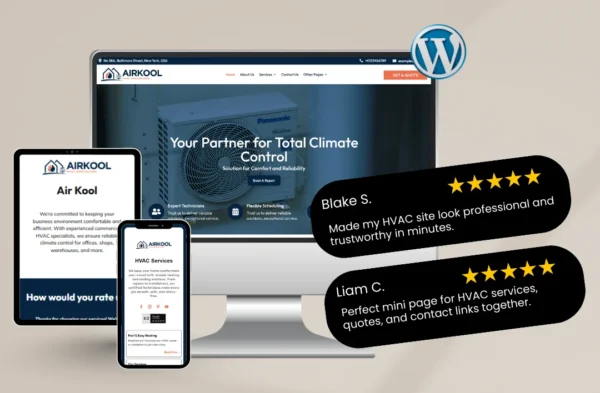
Comparison Table: Generic vs System-Built HVAC Websites
| Feature / Factor | Tempra HVAC Template | Generic Marketplace Theme | Custom Agency Build |
|---|---|---|---|
| Built For | HVAC & Plumbing Pros - high conversion | Every industry - optimized for none | Your brand - built from scratch |
| Urgent Services (Above-the-Fold) | Immediately visible - prioritized for emergencies | Often buried or missing | Custom designed for your specific USP |
| Service Pages | Dedicated pages - structured and decision-oriented | All services on one page - low clarity | Each page is billed individually ($$$) |
| Trust Signals | Verified reviews, technician photos & guarantees | Stock photos, no reviews, minimal proof | Custom case studies and high-end media |
| Navigation & Hierarchy | Logical, consistent, and easy to follow | Confusing, all services lumped together | Fully bespoke - can be complex to manage |
| Calls-to-Action (CTAs) | Prominent, clickable phone & booking buttons | Hidden or inconsistent | Integrated with custom CRM/Software |
| Conversion Focus | Pre-qualification system - filters unqualified leads | Passive browser, traffic-focused | Deep funnel optimization at extra cost |
| Mobile Experience | Fast, clickable CTAs, responsive layout | Slow, confusing, hard to act | Highly optimized, but expensive to maintain |
| Tracking & Analytics | Integrated call/form tracking for insights | Often missing | Full enterprise-grade data reporting |
| Operational Flexibility | Upgradeable, Divi editable, branding consistent | Limited - hard to scale | Developer needed for every small change |
| Performance | Lightweight - fast loading, no bloat | Slow - unnecessary plugins by default | Optimized, but at extra cost |
Pros & Cons of System-Built HVAC Websites
Pros:
- Prioritizes urgent, high-value services
- Builds trust instantly with reviews, guarantees, and technician credentials
- Guides visitors toward action (calls, forms)
- Filters unqualified leads automatically
- Supports operational flexibility and future growth
Cons:
- Requires careful design planning
- Needs consistent updates to maintain authority
What Happens After Structural Optimization
When HVAC websites are rebuilt around structured service segmentation, geographic alignment, and trust placement, measurable behavioral changes appear.
Bounce rates usually decrease because visitors encounter relevant information immediately.
Search engines begin associating the business with specific service-location entity combinations rather than diluted keyword signals.
But the most meaningful change is conversational.
Contractors begin receiving more targeted inquiries.
Instead of generic questions, calls sound more operational:
- Do you provide furnace repair in Brooklyn?
- Can you install AC systems in Manhattan this week?
The website starts pre-qualifying leads before human interaction begins.
This improves closing probability and shortens sales cycles.
The Core Industry Misunderstanding
Many HVAC contractors believe professional design alone creates business growth.
It does not.
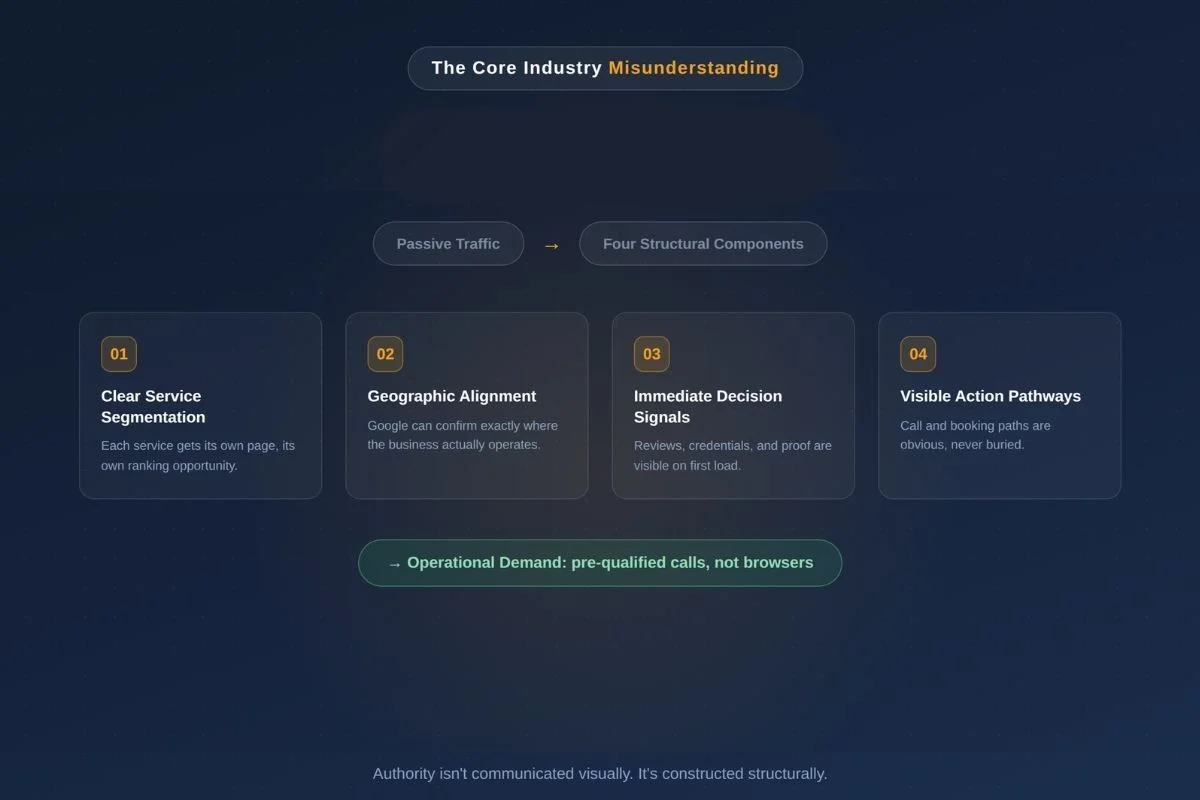
High-performance HVAC websites require four structural components working together:
- Clear service segmentation
- Geographic alignment
- Immediate decision signals
- Visible action pathways
Without these components, traffic remains passive.
With them, traffic becomes operational demand.
Authority is not communicated visually.
Authority is constructed structurally.
EEAT and Entity Authority Integration
From an EEAT perspective, structured HVAC websites demonstrate expertise through consistent operational logic.
Experience is communicated through service specialization.
Authority is reinforced through local presence, review integration, and structured service architecture.
Trustworthiness appears when visitors can quickly verify business capability, contact accessibility, and reputation evidence.
This design philosophy also supports long-term entity recognition inside search ecosystems and local map indexing.
Conclusion: Structure Determines Lead Quality
Most HVAC websites do not fail because of competition, marketing effort, or design quality.
They fail because they are built generically.
They attempt to appear complete rather than operate intelligently.
They chase traffic instead of intent.
True performance emerges when service clarity, geographic precision, trust reinforcement, and decision architecture work together.
A high-performing HVAC website is not just visually attractive.
It is a structured system engineered to convert visitors into qualified customers before the first phone call happens.
Sorry to hear that you’re not Satisfied.
Please provide us with your feedback and we’ll do our best to improve.
About the Author

Hassan leads the Plumber & HVAC division at Remote Sharks, building visibility and reputation systems for local service businesses. He focuses on search positioning, trust assets, and conversion-focused websites that generate real jobs not just traffic. At Themesrush, he creates ready-to-use website systems designed specifically for contractors who want structured growth, not guesswork.
More about Author
Find Your Website Issues
Free audit request.